

The Capabilities Behind Successful Servitisation
Popular Post
Tags
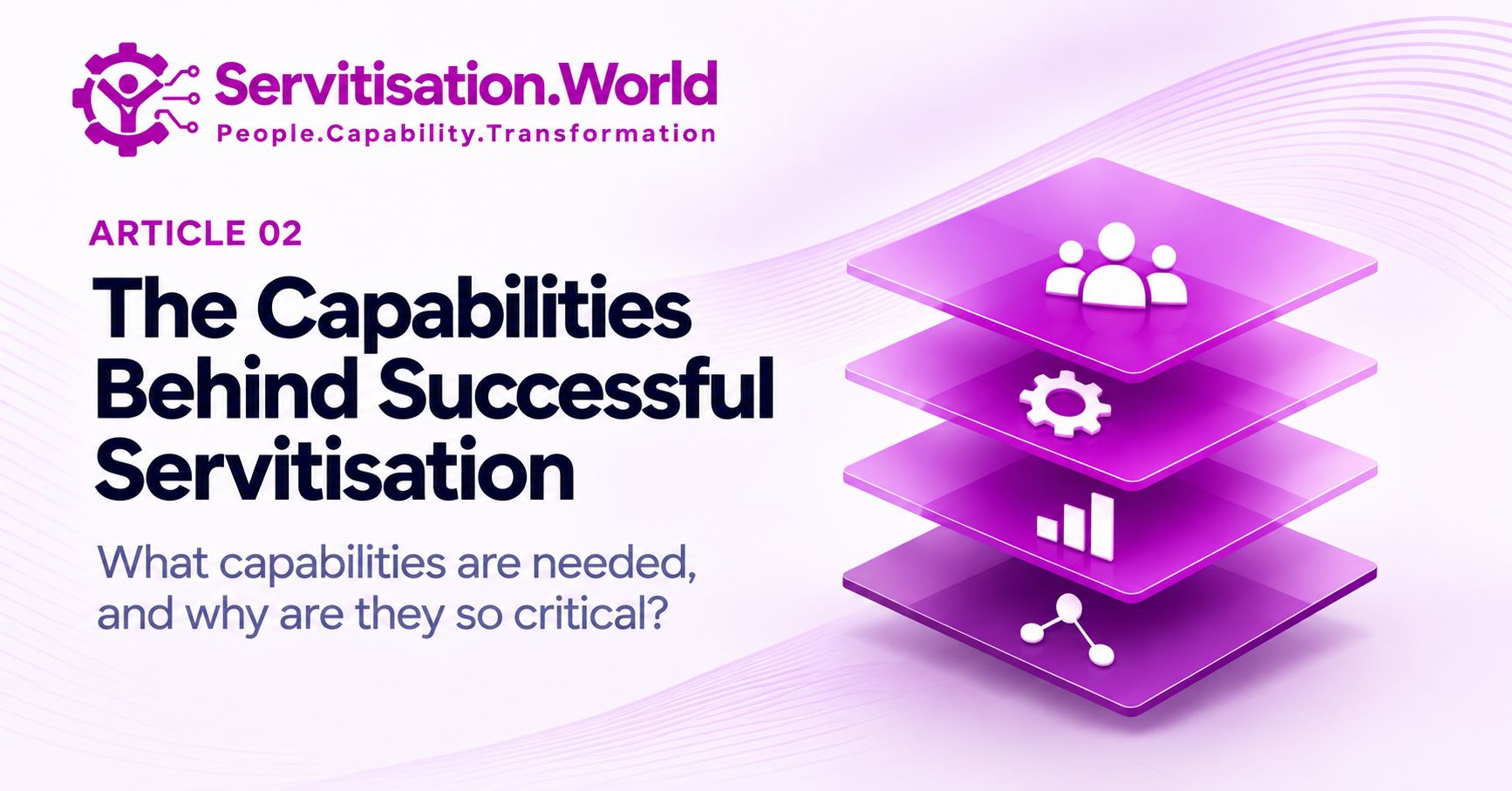
The Capabilities Behind Successful Servitisation
Most industrial companies do not begin a servitisation journey from zero. They already have service technicians, customer relationships, installed-base knowledge, engineering expertise and decades of experience keeping equipment running.
Yet as the ambition moves from selling products and supporting them towards managed services, smart services and customer outcomes, those existing strengths are no longer enough on their own.
The question therefore is not simply whether an organisation has strong capabilities. It is whether it has the right combination of capabilities for the next stage of its journey.
Capability is more than competence
When we talk about capability, it is tempting to think primarily about skills. But an organisational capability is broader than the expertise of an individual.
A company may employ excellent data scientists without being capable of building a profitable data-enabled service. It may have experienced service engineers without being capable of managing a multi-year availability contract. And it may have outstanding salespeople without being capable of selling outcomes.
Capability emerges when people, processes, technology, data, governance and commercial logic work together repeatedly. It is not what one talented individual can do. It is what the organisation can reliably do for customers at scale.
This distinction matters because servitisation often exposes gaps between individual expertise and organisational capability.
The capability portfolio changes with the journey
The capabilities required by a product-centric manufacturer are not the same as those required by a business taking responsibility for customer performance.
At the earlier stages, product reliability, technical expertise, spare-parts availability and field-service execution may dominate. As the business moves towards managed services, capabilities such as contract management, remote operations, lifecycle economics and performance management become more important.
Move further towards smart and autonomous services and the portfolio changes again. Data and software become more central. So do customer-process knowledge, risk modelling, ecosystem orchestration and the ability to continuously optimise an outcome rather than simply maintain an asset.
There is no universal capability list that every company should build. The relevant question is which capabilities become critical for the value proposition the organisation intends to deliver next.
A practical capability map
Although the mix varies by business and maturity, we repeatedly see a number of capability domains becoming more important as servitisation advances.
Customer & market insight — understanding how customers operate, where value is lost and which outcomes matter economically.
Service & solution innovation — translating customer problems into propositions that combine products, services, software and expertise.
Commercial & value selling — articulating value, engaging a broader buying group and selling a business result rather than a specification.
Pricing, contracting & risk — pricing uncertainty, structuring longer-term agreements and understanding which risks the provider can responsibly assume.
Digital & data — connecting assets, turning data into insight and embedding analytics or AI into repeatable service delivery.
Service operations & lifecycle management — delivering consistently across the installed base and managing performance over time.
Leadership, governance & change — aligning priorities, incentives, investment and accountability across functions that were often designed around product sales.
The value of a capability map is not the labels themselves. It is the conversation they create. Which of these are genuinely differentiating for us? Which are merely supporting capabilities? Where are we strong? Where are we dependent on individuals? And where is our ambition moving faster than our organisational ability to deliver?
The difficult part is the connections
Servitisation is cross-functional by nature. That makes the interfaces between capabilities as important as the capabilities themselves.
Customer insight without service innovation produces interesting observations but few propositions. Digital capability without commercial capability produces technology that may never find a viable market. A compelling outcome proposition without operational capability creates contractual risk. And excellent service delivery without the right pricing discipline can create growth without attractive returns.
This is one reason servitisation can feel frustratingly slow. Organisations may invest heavily in individual building blocks while underinvesting in the mechanisms that connect them.
Some capabilities need to be owned. Others can be accessed.
A capability strategy should not become a shopping list of functions that must all be built internally.
Some capabilities are so central to differentiation and customer intimacy that they should probably sit close to the core of the business. Others may be better accessed through technology partners, specialist providers or ecosystem relationships. Still others can be developed progressively as the service model proves itself.
The decision should depend on strategic importance, speed, scarcity and the degree of control required—not on an assumption that every capability gap must become a new department or a new hire.
This also introduces an important distinction between capability ownership and capability access. A manufacturer may not need to own every element of an IoT platform, for example, but it does need enough internal capability to understand how the platform contributes to customer value, economics and risk.
Start with the next stage, not the final destination
The temptation with capability transformation is to design the organisation required for an imagined future state. That can create complexity long before the business model needs it.
A more practical approach is to identify the next meaningful step in the servitisation journey and ask what must become true for that step to succeed.
What customer promise are we trying to make?
What must we be able to do consistently to keep that promise?
Which capabilities already exist at sufficient depth?
Which gaps would prevent us from scaling?
This keeps capability development anchored in strategy and customer value rather than organisational fashion.
Capability building is a leadership agenda
Capabilities do not develop simply because they appear on a transformation roadmap. They require choices about investment, ownership, incentives and time.
Leaders need to decide which capabilities deserve disproportionate attention, which legacy strengths must be preserved, where new ways of working need protection from the existing business, and how success will be measured while the economics are still developing.
They also need to recognise that capability building often crosses organisational boundaries. Sales may need service expertise. Service may need data capability. Digital teams may need deeper customer and commercial understanding. Finance may need to evaluate risk over a contract lifecycle rather than at the point of sale.
That is where a capability map becomes useful—not as a static maturity model, but as a way of focusing leadership attention on the few organisational abilities that will determine whether the next step creates value.
Three questions for your leadership team
Frequently Asked Questions
-
Q: 1. The Capabilities Behind Successful Servitisation
A: Successful servitisation typically requires capabilities across customer understanding, solution design, commercial management, sales, service delivery, digital and data, lifecycle management, partnerships, risk management, and people and organisation. The precise mix depends on the organisation's servitisation strategy and maturity.
-
Q: 2. Does every organisation need the same servitisation capabilities?
A: No. A manufacturer developing lifecycle services needs a different capability mix from one selling guaranteed uptime or outcome-based solutions. Capability requirements should therefore be driven by where the business is going, rather than by a generic servitisation model.
-
Q: 3. How do capability requirements change as servitisation matures?
A: As organisations progress from Product-Centric → Product + Service → Managed Services → Smart Services → Autonomous Services, capabilities generally become more integrated and sophisticated. Customer insight, data, commercial risk, solution design, ecosystem management and outcome delivery become increasingly important.
-
Q: 4. What is the difference between a skill and a capability?
A: A skill is something an individual can do. An organisational capability is something the business can repeatedly and reliably deliver. Capabilities therefore depend on more than individual skills; they combine people, knowledge, technology, processes, leadership, structure and ways of working.
-
Q: 5. Which servitisation capabilities should we build first?
A: Start with the capabilities required for your next strategic stage, not those required by the most advanced service organisations. Identify what will be critical to delivering the next generation of your service proposition and prioritise the gaps that could prevent execution.
-
Q: 6. How can we identify our servitisation capability gaps?
A: Define the strategic destination, identify the capabilities required to deliver it and assess the organisation's current strength in each area. The difference between required capability and current capability creates the capability gap—and provides a much stronger basis for investment decisions.
-
Q: 7. Should capability gaps automatically lead to recruitment?
A: No. Recruitment is only one response. Organisations can build capability through development, redeploy existing expertise, augment people with technology, partner with external organisations, access specialist expertise temporarily, or recruit where genuinely new capability is required.
-
Q: 8. Why are people and organisational capabilities so important?
A: Because servitisation changes roles, responsibilities and relationships across the organisation. Sales may need to sell value rather than products, operations may become responsible for customer outcomes, and functions that previously worked independently may need to operate as integrated teams. Technology alone cannot make those changes happen.
-
Q: 9. Who owns servitisation capability development?
A: It should not be treated simply as an HR responsibility. Business leaders own the capabilities their strategy requires. HR, L&D, technology and other functions can enable their development, but determining what the organisation must become capable of doing is fundamentally a strategic leadership responsibility.
-
Q: 10. Where should leadership teams start?
A: Start with three questions: Where are we now? Where are we trying to go? What must we become exceptionally good at to get there? From there, leadership can assess existing strengths, identify critical gaps and decide deliberately whether each capability should be built, bought, borrowed, partnered or technology-enabled.
Post a Comment
Get News and Job Notifications
Subscribe & get all relevant Servitisation updates
Comments (0)