

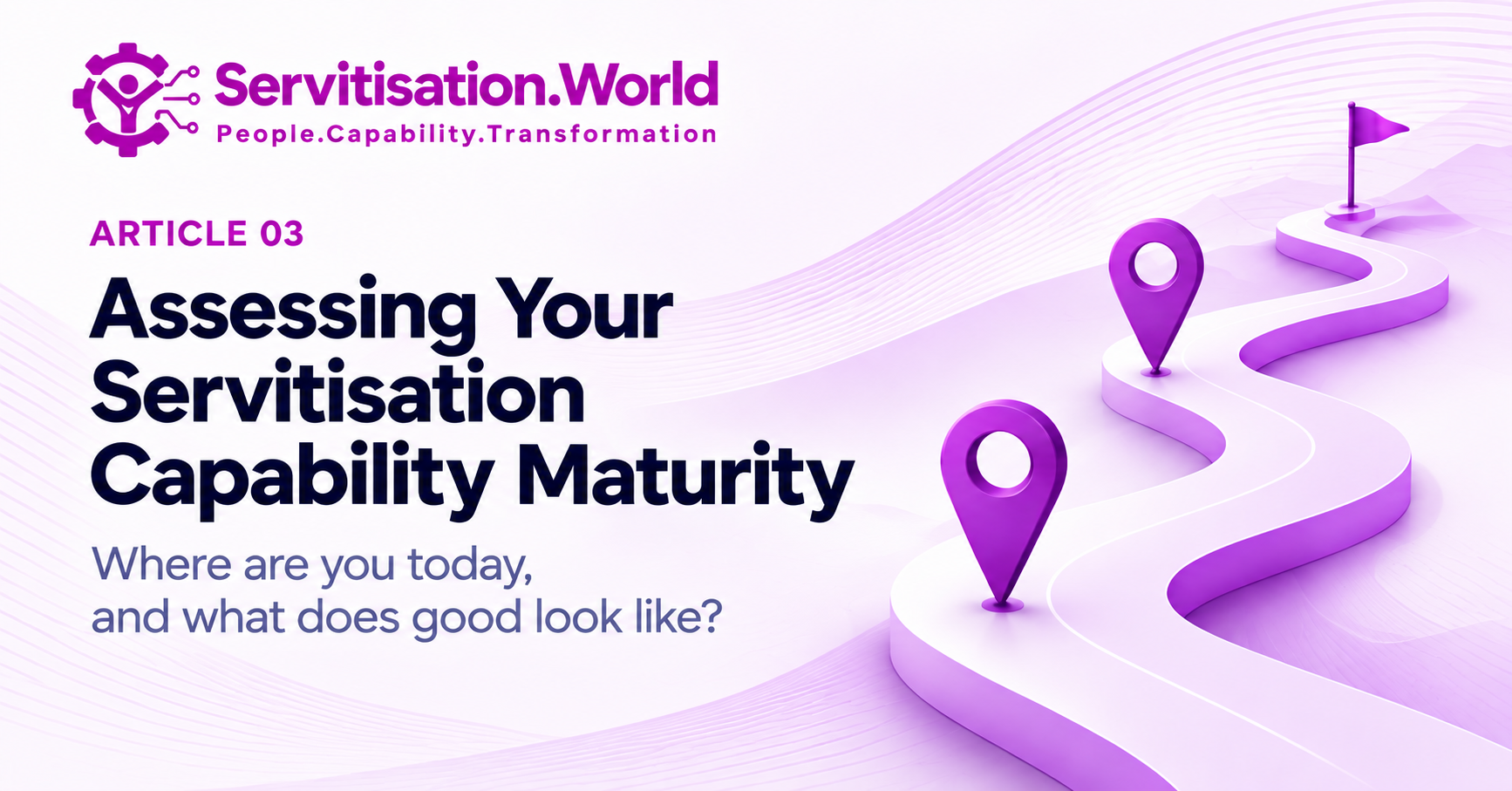
Assessing Your Servitisation Capability Maturity
Popular Post
Tags
Assessing Your Servitisation Capability Maturity
Assessing Your Servitisation Capability Maturity
Why deciding where you are actually trying to go matters more than climbing a maturity ladder — and how that choice turns capability assessment into a practical agenda.
Article 03 / 12Approx. 9 min read
Imagine two industrial companies.
Both have been pursuing servitisation for several years. Both have connected equipment in the field. Both offer service contracts. Both have invested significantly in digital technology. And both report growing service revenues.
Ask them where they are on their servitisation journey and they might give you very similar answers.
Look inside the organisations, however, and they may be remarkably different.
In the first company, salespeople understand how to quantify the economic impact of downtime on the customer's operation. Service, product and digital teams develop propositions together. Commercial teams are comfortable structuring multi-year agreements. Operational performance is visible throughout the lifecycle, and management understands the risks associated with the commitments it makes.
In the second company, the technology may be every bit as sophisticated, but sales is still largely product-led. Service sits downstream from the product business. Data is collected but not consistently translated into customer value. Commercial teams remain uncomfortable with performance commitments, and nobody is entirely sure who owns the customer outcome once the contract has been signed.
Which company is more mature?
The answer seems obvious. And yet a conventional servitisation maturity assessment might place them surprisingly close together.
That points to a problem with the way we sometimes think about maturity.
Maturity is not a position on a ladder
Maturity models are appealing because they make a complicated transformation understandable. We assess a number of dimensions, assign scores and place the organisation somewhere on a journey from relatively traditional to highly advanced.
That can be useful. But it can also imply that organisations move neatly from one level to another. Reality tends to be messier.
An industrial company can have highly sophisticated digital capability and relatively immature commercial capability. It can be excellent at service operations but weak at customer insight. It can have salespeople capable of discussing customer outcomes while its contracts, incentives and governance remain firmly rooted in a product business.
In other words, an organisation does not have one maturity. It has a pattern of capabilities that have developed at different speeds.
That distinction matters because servitisation depends on those capabilities working together.
The question may not be: How mature are we?
A better question is: Are our capabilities mature enough for the business model we are trying to deliver?
The harder question comes first
Before assessing capability maturity, there is a more difficult question to answer.
Where are we actually trying to go?
It is tempting to look at a servitisation journey and assume that the objective is to keep moving from left to right: from Product-Centric, through Product + Service and Managed Services, towards Smart and eventually Autonomous Services.
THE SERVITISATION.WORLD JOURNEY
01 Product-CentricEquipment and product performance
02 Product + ServiceLifecycle support and service
03 Managed ServicesAvailability and managed performance
04 Smart ServicesData-enabled optimisation
05 Autonomous ServicesOutcomes and increasing autonomy
But these are not levels to be completed. They represent different ways in which an industrial company can create value and take responsibility for customer performance.
The strategic challenge is deciding where on that journey the business should compete. That requires understanding where customers genuinely value greater supplier involvement, what problems they will pay to have solved, where the supplier has — or could develop — a distinctive advantage, how attractive the economics are, and how much additional risk the company is prepared to accept.
A manufacturer may discover that customers value exceptional lifecycle support but have little interest in transferring responsibility for outcomes. Another may find that downtime is so economically significant that customers are willing to pay for guaranteed availability. Another may have a combination of installed-base knowledge, connectivity, data and domain expertise that creates an opportunity to optimise customer performance.
The right destination is therefore unlikely to be determined by a maturity model. It emerges from the intersection of customer value, competitive advantage, economic attractiveness and acceptable risk.
The objective is not to travel as far as possible along the servitisation journey. It is to find the position where taking greater responsibility for customer performance creates compelling value for the customer and attractive economics for the provider.
Technology does not choose the destination
IoT illustrates the problem particularly well.
Industrial companies have spent years connecting products, collecting data and building remote-monitoring capabilities. The technological possibilities are exciting. We can see how equipment is being used, detect anomalies, predict failures and increasingly optimise performance.
But there is a much harder question: how do we make money from it?
The answer is rarely simply to sell the data. The economic value usually appears when connectivity and data allow the supplier to solve a more valuable customer problem.
Better data might improve preventive maintenance, reduce unplanned downtime, support guaranteed availability, improve energy efficiency or throughput, or eventually enable the supplier to take responsibility for an operational outcome.
Those are very different business models — requiring very different capabilities.
This is why investment in IoT can run ahead of commercial progress. A company can become extremely sophisticated at collecting data without becoming equally sophisticated at turning that data into customer value — and capturing some of that value commercially.
Many industrial companies know how to connect their products. Far fewer know what business they want that connectivity to enable.
The strategic task is to determine which customer problem the technology allows us to solve better, how much solving that problem is worth, and what role we want to play in delivering that value.
Only then does the destination begin to become clearer.
Once the destination becomes clearer, the capability question changes
Once leadership has a clearer destination, it can work backwards. What must the organisation be capable of doing to sell, contract, deliver and manage that business model successfully? What additional capabilities become critical, and what new risks must it understand and manage?
Capability maturity is no longer an abstract assessment. It has a purpose.
Destination
Required capabilitiesCurrent capabilitiesCapability gapsDevelopment prioritiesThe difficult strategic question is where should we go?The capability question becomes: What must we become capable of doing to get there?
That does not make capability development easy. But it makes the problem tangible. Instead of becoming more “mature” across every dimension, management can concentrate investment on the capabilities critical to the business model it has chosen.
And that changes the purpose of assessment. We are no longer measuring how far an organisation has progressed towards somebody else's theoretical end state. We are assessing whether it has the capabilities required to deliver its chosen destination.
The interesting part is often the gap
Consider a manufacturer that wants to develop a significant Smart Services business.
It has invested heavily in connectivity, remote monitoring and analytics. Its equipment generates large volumes of operational data and it can identify patterns, anticipate failures and increasingly predict performance. From a technology perspective, it looks advanced.
But follow the proposition into the rest of the organisation.
Can the commercial team translate those insights into an economic case that matters to the customer? Can sales move the conversation from equipment performance to customer performance? Can the organisation price the value it creates rather than simply the cost of providing the service? Can contracts accommodate new responsibilities? Can operations consistently deliver against them? And are product, digital, service and commercial teams actually working as one system?
The company may not have a technology problem at all. It may have a capability imbalance. More investment in analytics might strengthen what it already does well while doing little about the capabilities actually constraining growth.
A score asks: “How advanced are we?” A capability profile asks: “Where are we strong, where are we exposed, and does that pattern match where we are trying to go?”
Your strongest capability may not determine how far you can go
This becomes particularly important as companies move towards performance and outcome commitments.
Imagine that our manufacturer has developed excellent predictive-maintenance technology. Its installed base is connected, its models identify potential failures accurately and its engineers understand the equipment intimately. The company decides it is ready to guarantee availability.
Technically, perhaps it is.
But can it quantify the financial exposure associated with that guarantee? Can it distinguish between risks it can control and risks it cannot? Can it price those risks appropriately? Can the contract define the customer's responsibilities as clearly as the supplier's? Can the service organisation intervene quickly enough when the data signals a problem? Can the company manage the commercial consequences when performance falls below commitment?
If the answer to one of those questions is no, then the sophistication of the predictive algorithm becomes less important.
The business model is only as robust as the capabilities required to deliver it.
The maturity of a servitised business may be determined less by its strongest capability than by its weakest critical capability.
Not its weakest capability overall. Its weakest critical capability. And what counts as critical can only be defined once the destination is understood.
No organisation needs to be world-class at everything. Nor should every capability be developed to the same level. What matters is whether the capabilities essential to the next stage of the business model are sufficiently strong — and sufficiently connected — to make that model work.
This changes what we should assess
In the previous article, we looked at the capabilities behind successful servitisation: customer and market insight, service and solution innovation, commercial and value selling, pricing and risk, digital and data, service operations, and leadership and organisation.
Those categories are useful. But the value does not come from scoring each one from one to five. It comes from putting them alongside the company's strategic ambition and looking at the shape that emerges.
Where are we today?
Where does our strategy require us to be?Where is the distance between the two significant enough to matter?Where could one capability gap prevent several other investments from creating value?For our Smart Services manufacturer, that might reveal something uncomfortable. Digital and data may already be where they need to be. Customer insight may be close. Service operations may require some development. But commercial capability, contracting and organisational integration may be significantly behind.Suddenly the investment conversation changes. The next euro might create more value in commercial capability than in another layer of technology. That is the kind of insight a maturity assessment should produce.
Capability is what the organisation can repeatedly do
There is one final complication: organisations are not always very good at assessing themselves. Most leadership teams will describe their business as customer-centric, digitally capable and collaborative.
The problem is that aspiration can easily be mistaken for capability.
A company is not customer-centric because customer centricity appears in its strategy presentation. It is customer-centric if its people repeatedly demonstrate a deep understanding of customer operations and use that understanding to make better decisions.
It does not have strong digital capability simply because equipment is connected. It has strong digital capability when it can repeatedly turn data into decisions and customer value.
And it does not have solution-selling capability because salespeople attended a solution-selling programme. It has that capability when the organisation can repeatedly identify, quantify, sell and capture value from solutions.
Capability is not what an organisation knows it should do. It is what the organisation can repeatedly do.
That is much harder to assess with a questionnaire. It is also much closer to reality.
The purpose is clarity
This is where maturity models can distract us most. The score becomes the output: the spider chart is presented to management, red areas become amber, amber areas become green, and twelve months later the assessment is repeated.
But nobody buys a service because its supplier improved its maturity score. The most important output of the discussion may not be a score at all.
It is clarity.
Clarity about where the company intends to create value. Clarity about how much responsibility it is prepared to take for customer performance. Clarity about the capabilities that business model requires. And clarity about the few capability gaps that could prevent it from succeeding.
Once the destination becomes clearer, the capability agenda becomes easier to define: what we already do well, what needs to become stronger, what needs to be created and, eventually, whether those capabilities should be built internally, accessed through partners or brought into the organisation.
But those decisions come later.
The first — and arguably harder — question is:
Where are we actually trying to go?
Because capability maturity only becomes meaningful when we know what we are trying to become capable of.
Strategy determines the destination. Capability determines whether you can get there.
Three questions for your leadership team
01
Where on the servitisation journey could we create the greatest value for our customers — and attractive economics for ourselves?
02
What would we need to become capable of doing consistently to succeed there?
03
Which critical capabilities are furthest behind that ambition today?
NEXT IN THE SERVITISATION CAPABILITY JOURNEY · 04 / 12
Developing Customer Insight and Operational Understanding
Moving from knowing your product to understanding your customer's operation.
Servitisation.World · People. Capability. Transformation.From Product to Outcome · 03 / 12
Frequently Asked Questions
-
Q: 1. What is servitisation capability maturity?
A: Servitisation capability maturity describes how effectively an organisation can repeatedly perform the activities required to deliver its chosen service-based business model. It extends beyond technology and service offerings to include customer understanding, commercial capability, operational delivery, leadership, governance and organisational integration. The key distinction: Maturity is not simply how advanced an organisation appears. It is whether its capabilities are sufficiently developed to deliver its strategic ambition.
-
Q: 2. Why is a traditional maturity score not enough?
A: A single maturity score can conceal significant differences between capabilities. An organisation might have sophisticated digital technology but relatively weak commercial skills, contracting expertise or customer insight. Two businesses with similar maturity scores may therefore have very different abilities to deliver customer outcomes. What matters is the pattern of capabilities, not simply the overall score.
-
Q: 3. Does every organisation need to progress towards Autonomous Services?
A: No. Autonomous Services should not automatically be considered the ultimate destination for every industrial business. Some organisations may create greater customer value and stronger financial returns through exceptional lifecycle support, Managed Services or Smart Services. The appropriate destination depends on customer needs, competitive advantage, economic attractiveness and acceptable risk. The objective is not to travel furthest. It is to compete where the business can create and capture the greatest sustainable value.
-
Q: 4. What should a company decide before assessing its capability maturity?
A: It should first determine where it intends to compete on the servitisation journey. That requires leadership to understand which customer problems it wants to solve, what customers will pay for, the value the business can create and the responsibilities it is prepared to accept. Only then can the organisation establish which capabilities are essential to delivering that business model. Strategy determines the destination. Capability determines whether the organisation can get there.
-
Q: 5. Why doesn't investment in digital technology automatically create servitisation maturity?
A: Because technological sophistication does not necessarily translate into commercial value. An organisation may connect equipment, collect operational data and develop predictive analytics without knowing how to turn those capabilities into propositions customers will purchase. The commercial opportunity emerges when technology enables the supplier to solve valuable customer problems, such as reducing downtime, improving availability or optimising operational performance. Connectivity creates possibilities. Organisational capability turns those possibilities into customer value and commercial returns.
-
Q: 6. What is a servitisation capability gap?
A: A capability gap is the difference between what an organisation can consistently deliver today and what it must be capable of delivering to achieve its chosen business model. For example, a manufacturer pursuing Smart Services may already have excellent data analytics but lack the commercial capability to quantify customer value, price outcomes or structure performance-based agreements. The most important gaps are those that could prevent the business model from succeeding. Capability development should prioritise strategically critical gaps, not attempt to improve everything equally.
-
Q: 7. Can one weak capability hold back an otherwise advanced servitisation business?
A: Yes. The success of a servitised business can depend on its weakest critical capability. A company might have excellent predictive-maintenance technology but lack the contracting, risk-management or operational capabilities necessary to guarantee equipment availability. Its technical sophistication cannot compensate for an inability to manage the commercial and operational commitments it makes. A business model is only as robust as the critical capabilities required to deliver it.
-
Q: 8. How should leadership assess servitisation capability maturity?
A: Leadership should compare current organisational capabilities against those required by its chosen strategic destination. The assessment should establish: - Where the organisation is strong today. - Which capabilities its intended business model requires. - Where significant gaps exist. - Which gaps present the greatest commercial or operational risk. - Where targeted investment would create the greatest value. The result should be a prioritised capability development agenda, rather than simply a maturity score or dashboard.
-
Q: 9. How can an organisation distinguish genuine capability from aspiration?
A: By examining what the organisation can repeatedly demonstrate in practice, rather than what it claims to understand or intends to achieve. For example, completing solution-selling training does not establish solution-selling capability. Genuine capability exists when commercial teams consistently identify customer problems, quantify their economic impact, develop appropriate solutions and capture value through successful commercial agreements. Similarly, having connected equipment does not establish digital capability unless the organisation consistently converts data into decisions and customer value. Capability is not what an organisation knows it should do. It is what the organisation can repeatedly do.
-
Q: 10. What should be the ultimate outcome of a servitisation capability maturity assessment?
A: The most valuable outcome is strategic clarity and a focused development agenda. Leadership should understand where the organisation intends to create customer value, which capabilities are essential to delivering that ambition and which weaknesses could prevent success. That understanding enables more informed decisions about where to invest, which skills to develop, what processes to strengthen and whether capabilities should be built internally, accessed through partners or recruited into the business. The purpose of assessment is not to achieve a higher maturity score. It is to build an organisation capable of delivering its chosen future.
Post a Comment
Get News and Job Notifications
Subscribe & get all relevant Servitisation updates
Comments (0)